Why Fans and Open Windows Don't Dry a Flooded House
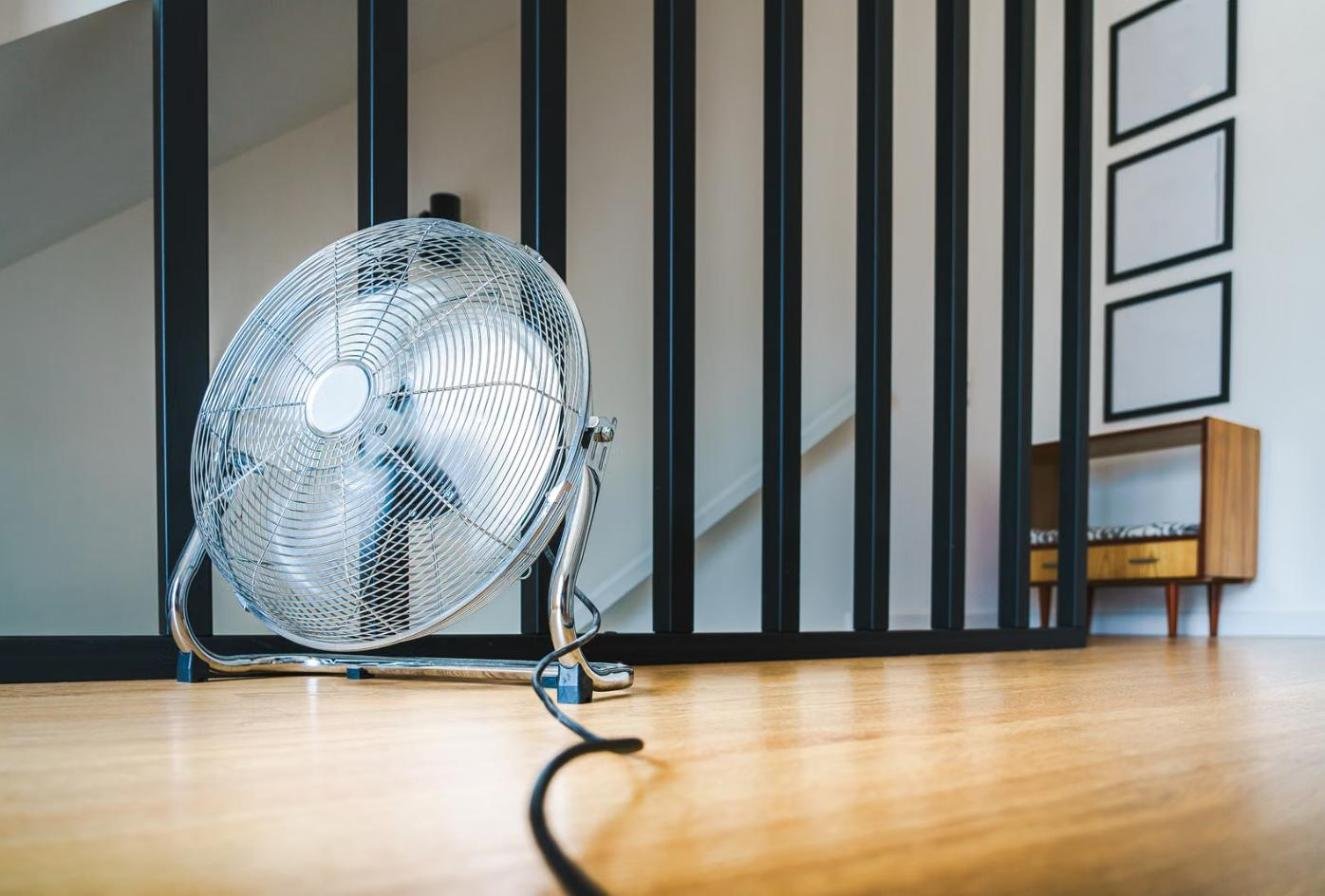
Drying water damage with fans and open windows works for a small spill on a hard floor, and almost never for a real leak. Fans move water from wet surfaces into the air, but they do nothing to remove it from the house, and they cannot reach the water inside walls, under flooring or in the framing. The room ends up feeling dry while the materials that matter stay wet.
Where the water goes when you run a fan
A fan does one thing. It blows air across a wet surface, and that air picks up water as vapour. The water has not left. It is now in the air of the room. As the air gets more humid, it picks up less and less, and evaporation slows to a crawl.
That humid air then drifts through the house and gives its moisture back to anything cooler or drier than it is: closet walls, the back of furniture, window frames, clothing, books, the ceiling of the next room. Restorers call this secondary damage. It is common to find mold in a room the water never touched because a wet basement was left to air out with a couple of fans.
Proper drying has two halves. Air movement gets the water out of the material. Dehumidification takes it out of the air and sends it down a drain. Fans alone are only the first half.
Why open windows usually make it worse
Opening windows seems like the obvious fix for humid air. It only helps if the outdoor air is drier than the indoor air, and you have no easy way to know that by feel.
In a London summer the outdoor air is often heavy with moisture, especially overnight and after rain. Open windows on a humid July evening bring in more water than they let out. Wet materials can actually gain moisture.
In winter the outdoor air holds very little water, so in theory it dries well. In practice you are pouring cold air onto wet materials. Cold slows evaporation, the furnace runs flat out, pipes near the open window are at risk and nobody can keep it up for the days that drying takes. Spring and fall give you the occasional good drying day, but the weather changes by the hour and the windows have to close at night anyway.
What fans cannot reach
Most of the water from a leak is not on the surface. Within minutes it runs under baseboards, soaks the bottom plate of the wall, wicks up the back of the drywall and spreads across the subfloor under the finished floor. A box fan or pedestal fan pushes a soft, wide stream of air through the middle of the room. It does not put fast air along the base of the wall, and it does nothing for a wall cavity, the space under cabinets or the underpad beneath a carpet.
The surface dries first because it is the easy part. The paint looks fine, the carpet feels dry on top, and the fan gets put away. A week or two later there is a musty smell, baseboards start to pull away, or a dark line shows up along the bottom of the wall. By then it is a mold job on top of a water job.
When drying water damage with fans is enough
Fans and a household dehumidifier are a reasonable answer when all of these are true:
- The water was clean, from a supply line, tap or appliance, not a drain or sewer.
- It was a small amount and you caught it within an hour or so.
- It landed on a hard surface such as sealed tile, sheet vinyl or bare concrete.
- It did not reach a wall, run under baseboards, cabinets or a floating floor, or drip through to the level below.
- You can see and touch every surface that got wet.
If any one of those is not true, there is likely water somewhere you cannot see, and the only way to know is to check with a moisture meter.
What to do in the first few hours
While you are sorting out next steps, these help and do no harm:
- Stop the water at the fixture or the main shutoff.
- If water is near outlets, cords or the electrical panel, stay out of it and switch off the breakers for that area if you can reach the panel safely.
- Mop, towel or wet-vac up standing water. Every litre you pick up is a litre that does not have to evaporate.
- Lift furniture legs onto blocks or foil, and move rugs, boxes and curtains out of the wet area.
- Keep windows closed. Run the air conditioning in summer or normal heat in winter, and run a dehumidifier if you own one, emptying it often.
- Use your fans, aimed low along the wet edges. They do help once something is pulling the moisture out of the air.
- Take photos of everything before you move it.
Then get the walls and floor checked with a meter within a day. If the readings come back dry, your fans did the job and you have lost nothing. If they do not, you have caught it while it is still a drying job.
Common questions
Will a household dehumidifier dry a flooded basement?
It helps with a damp room, but a home unit removes a fraction of what a commercial one does and struggles once the air gets drier. For a truly flooded basement it will not keep up with the amount of water coming out of the materials.
Should I turn the heat up to dry things faster?
Normal room temperature is best, roughly 20 to 25 °C. Extra heat without dehumidification just makes warm, humid air, which is ideal for mold.
How do I know if there is water inside the wall?
You usually cannot tell by looking or touching. A moisture meter reading at the base of the wall, compared to a dry wall elsewhere in the house, is the reliable check, and a thermal camera helps find where to test.
Send photos, get a firm quote in 2 hours
Three photos from your phone is enough for most jobs. No obligation.